Afghan Warrior: U.S. Navy SEAL's Stories of Valor in Afghanistan: SEAL Team Six by Steve Stone
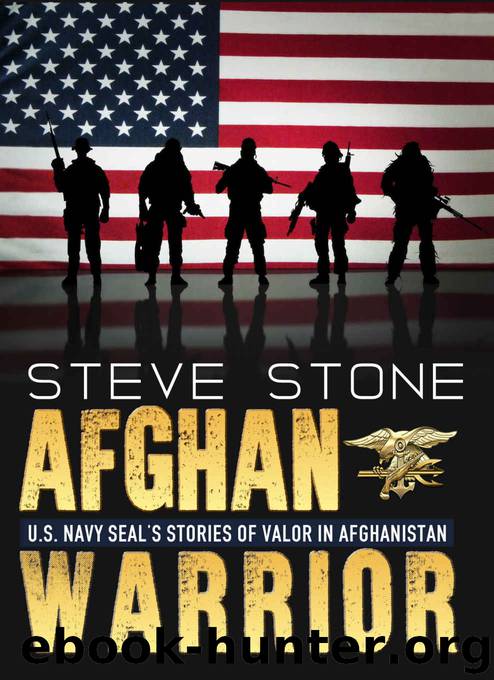
Author:Steve Stone [Stone, Steve]
Language: eng
Format: epub
Amazon: B019OSW7SQ
Publisher: Digital Dreams
Published: 2016-01-07T16:00:00+00:00
CHAPTER NINE – AFGHAN WAR
Afghanistan War and Islamic Fundamentalism
In the late 1970s the Afghan government faced increasing opposition to its social policies. By 1979 guerrilla opposition forces, popularly called mujahidin, were active in much of the country, fighting both Soviet forces and the Soviet-backed Afghan government. In 1986, Karmal resigned and was replaced by Mohammad Najibullah. The country was devastated by the 1979 - 89 War. The war caused an enormous human and economic toll. Following the Soviet withdrawal, the government steadily lost ground to the guerrilla forces. In early 1992, Kabul was captured, and the guerrilla alliance set up a new government consisting of a 50-member ruling council. Burhanuddin Rabbani was named interim president.
However, the guerrillas even in victory were unable to unite and Gulbuddin Hekmatyar a guerrilla leader used his forces to launch attacks on the government. The fighting caused Afghanistan to become divided into several independent zones, each with its own ruler. From late 1994 a militia of Pashtun Islamic fundamentalist students called the ‘Taliban’ emerged as an increasingly powerful force. During early 1996, as the Taliban continued its attempt to gain control of Afghanistan, Rabbani and Hekmatyar signed a power-sharing accord that made Hekmatyar premier. In September 1996 the Taliban captured Kabul and declared themselves the legitimate government of the Islamic Emirate of Afghanistan. As soon as they took control they imposed a harsh form of Islamic law in the two thirds of the country they controlled.
By Aug 1998 the Taliban were on the verge of taking over the whole country. In March 1999, UN-brokered a peace agreement between the Taliban and the forces of the Northern Alliance, under Ahmed Shah Massoud, an ethnic Tajik and former mujahidin leader.
However, this did not last for long with fighting starting again in July 1998. In November, the United Nations imposed economic sanctions on Afghanistan. This action and the 1998 missile attacks on a terrorist training base by America were related to the refusal by Afghanistan to turn over bin Laden. Additional UN sanctions, including a ban on arms sales to Taliban forces, were imposed in December 2000.
By 2000 the Taliban controlled some 90% of the country. However, the government was not recognized by the international community including the UN and Northern Alliance. The war in Afghanistan had caused over one million deaths and a further three million Afghans took refuge in Pakistan and Iran. A drought that began in the late 1990s added to Afghanistan’s plight.
In early 2001 the Taliban militia destroyed all statues in the nation, including two ancient giant Buddhas in Bamian, outside Kabul. The destruction was ordered by religious leaders, who regarded the figures as idolatrous and un-Islamic. This action was met with widespread international dismay and condemnation, even from other Islamic nations. In September 2001, Massoud died as a result of a suicide bomb attack by assassins posing as Arab journalists. This was a severe blow to the Northern Alliance. Then two days after that attack, was 9/11 which immediately led to bin Landen becoming the worlds most wanted man.
Download
This site does not store any files on its server. We only index and link to content provided by other sites. Please contact the content providers to delete copyright contents if any and email us, we'll remove relevant links or contents immediately.
| Africa | Americas |
| Arctic & Antarctica | Asia |
| Australia & Oceania | Europe |
| Middle East | Russia |
| United States | World |
| Ancient Civilizations | Military |
| Historical Study & Educational Resources |
The Radium Girls by Kate Moore(12036)
100 Deadly Skills by Clint Emerson(4932)
Rise and Kill First by Ronen Bergman(4797)
The Templars by Dan Jones(4695)
The Doomsday Machine by Daniel Ellsberg(4493)
The Rape of Nanking by Iris Chang(4224)
Killing England by Bill O'Reilly(4008)
Stalin by Stephen Kotkin(3973)
Hitler in Los Angeles by Steven J. Ross(3949)
12 Strong by Doug Stanton(3554)
Hitler's Monsters by Eric Kurlander(3348)
Blood and Sand by Alex Von Tunzelmann(3207)
The Code Book by Simon Singh(3197)
Darkest Hour by Anthony McCarten(3135)
The Art of War Visualized by Jessica Hagy(3014)
Hitler's Flying Saucers: A Guide to German Flying Discs of the Second World War by Stevens Henry(2759)
Babylon's Ark by Lawrence Anthony(2686)
The Second World Wars by Victor Davis Hanson(2529)
Tobruk by Peter Fitzsimons(2521)
